OCD

Obsessive Compulsive Disorder (OCD) is a very common mental health condition ‘where a person has obsessive thoughts and compulsive behaviours.‘ (https://www.nhs.uk/conditions/obsessive-compulsive-disorder-ocd/)

OCD can occur in Men and Females of all ages. OCD can really disrupt your life, especially if you have a severe case of it.

The symptoms of OCD on the NHS website are :

  • usually experience frequent obsessive thoughts and compulsive behaviours.An obsession is an unwanted and unpleasant thought, image or urge that repeatedly enters your mind, causing feelings of anxiety, disgust or unease.
  • A compulsion is a repetitive behaviour or mental act that you feel you need to do to temporarily relieve the unpleasant feelings brought on by the obsessive thought. 

An example of this could be touching a door handle 4 times to make sure its locked.

I personally have a mild case of OCD compared to some people, although sometimes it becomes very stressful and overwhelming. I have found that sometimes I obsess in my mind over something for example cleaning my room, I will overthink it to the point I have sat on my bed for half an hour thinking about each step of how I should clean my room and then I have to do it otherwise I will continue to sit there and think it through another 100 times. It becomes tiring as I have it with a lot of things I do, I wouldn’t say its me obsessing over cleaning, but rather the action of doing it and how I will do it correctly so that it will feel right. I have sometimes found myself obsessing over how I did my hair or my makeup, and sitting in front of the mirror for an hour and a half going through and talking to myself about the steps I did to make it look how it does, so that I can do it again exactly the same, but I will repeat it over and over to myself, in a sort of routine. Another example, is going into the fridge to check the sell by dates on food, and once I’ve looked once, I find myself walking around the room then coming back to do it again and again maybe 4-5 times, just to check, as I feel uneasy if I don’t and in my head I’m not sure what will happen if I don’t do it again. I don’t seem to have a problem with mess like some people with OCD, but I do just get obsessive thoughts about an action of doing something, which gives me anxiety if I then can’t do it. I think I dislike being out of control, and this is when my obsessive thoughts and overthinking will begin. I find it hard to cope with most of the time. I think it gets worse when I am stressed about something or doing something and I get so anxious and uneasy, that the thoughts become obsessive and I can only break out of them once I have repeatedly told myself enough times how I will do it, and then usually I have to do the action if telling myself isn’t enough to make me feel calmer. It is generally quite hard to explain exactly what happens within my head, as I don’t exactly understand it myself. I can go some days without it happening as noticeably, and some days I will just obsess over one thing and be thinking about it all day until I get distracted. I don’t get it as much or as strongly when I’m with other people; I may get thoughts but they’ll go quiet as I get distracted, I usually get it badly when I am on my own as I get so involved with the thoughts and have no way to switch them off or change my thought process.

If you think you or someone you know has OCD get in contact with your GP

‘ they’ll ask about your symptoms and can refer you to a local psychological therapies service if necessary’ (https://www.nhs.uk/conditions/obsessive-compulsive-disorder-ocd/)

OCD isn’t something that usually goes without some sort of treatment. Therapy is always helpful, and they may prescribe you ‘a type of antidepressant medicine called selective serotonin reuptake inhibitors (SSRIs) which can help by altering the balance of chemicals in your brain’ (https://www.nhs.uk/conditions/obsessive-compulsive-disorder-ocd/)

From experience living with OCD is hard, and in my case its not as severe as some people, so finding someone to talk to about it, or get support from is important.

‘Based on current estimates for the UK population, there are around three quarters of a million people living with OCD at any one time. What we know about OCD is that the condition affects as many as 12 in every 1,000 people (1.2% of the population) from young children to adults, regardless of gender, social or cultural background.’ (https://www.ocduk.org/ocd/how-common-is-ocd/)
A 3 minute Video explaining OCD and what happens with compulsions, and how to acknowledge the problem is the anxiety behind the compulsive thoughts.
Samantha Pena does a TED talk on her OCD and how it effects but also brings some advantages to her life.

BULIMIA

Bulimia is a mental health condition and an eating disorder.

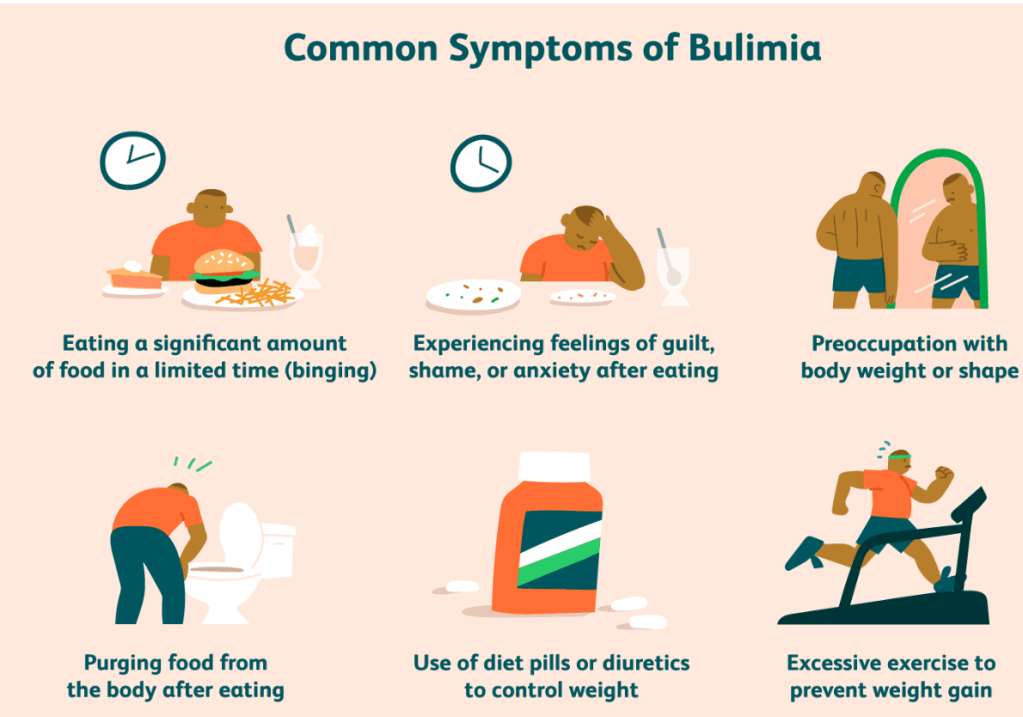
On the left, you can see the common symptoms of bulimia, eating a lot then feeling guilt for doing so, then going to throw it up because you think you look overweight and therefore have to get rid of what you have eaten.

Bulimia is often very hard to see in someone else unless you are around them when they are throwing the food up, but usually people with bulimia are very secretive, as they don’t want people to know what they have been doing as they feel such guilt for it.

My twin sister experienced bulimia, and she has allowed me to share her story.

It was very difficult seeing my sister get so paranoid about her weight, when to me her body looked so good and was slim and toned and didn’t need changing, but to her she looked fat and would constantly be asking me if she looked ok. She became so paranoid and I couldn’t understand why, until one day I was with her in her flat and we both ate a big takeaway, and I could see her getting agitated, and she kept asking me to take the food down to the bins, but I told her I would take them when I was leaving. This was a moment I will not forget, as she burst into tears and ran to the toilet, and I obviously was so shocked and confused, and I heard her trying to make herself sick and I ran in and stopped her and had to hold her in my arms unil she stopped crying. She finally told me she had been doing this for months, and she didn’t know what to do. She had been seeing a dentist as well privately as every time she threw up the stomach acid would break her teeth down. It was awful to hear that she had been suffering and I had no idea, and as soon as she then spoke about it she knew she needed to get help. When she did get help she was so much happier, and she is now confident in herself, and no longer suffers from it!

It is so hard to notice the signs, even me with my Twin I thought I knew the ins and outs of her life as we are so close, and yet I still didn’t see the signs. It is so important that people remember the symptoms and if they see any of them occurring, to try and help before it gets so severe they become really ill.

‘Bulimia affects more girls and women than boys and men.’

‘Bulimia affects more girls and younger women than older women. On average, women develop bulimia at 18 or 19. Teen girls between 15 and 19 and young women in their early 20s are most at risk. But eating disorders are happening more often in older women.’ (https://www.womenshealth.gov/mental-health/mental-health-conditions/eating-disorders/bulimia-nervosa)

In this day and age social media has made body image such a big deal, as people are constantly comparing themselves to others, especially young women who want to look like the women portrayed on social media, on television and in magazines. Bulimia is occurring due to people thinking they don’t look good enough and then it becomes an obsession and creates eating disorders like this.

If you or someone you know is suffering from bulimia you must see your GP as they will be able to provide you with information and treatments. On the NHS website it says that : (https://www.nhs.uk/conditions/bulimia/)

‘They’ll ask you questions about your eating habits and how you’re feeling, and will check your overall health and weight.  ‘

‘If they think you may have bulimia or another eating disorder, they should refer you to an eating disorder specialist or team of specialists. ‘

‘It can be very hard to admit you have a problem and ask for help. It may make things easier if you bring a friend or loved one with you to your appointment.’

Treatment is through Therapy which helps a lot as I’ve seen first hand as my twin had therapy to help her. Sometimes it can just go away if you’re able to stop the habit yourself, but if not then seek help.

A Helpline you can call is :

Beat – adult helpline on 0808 801 0677 or youth helpline on 0808 801 0711

(https://www.beateatingdisorders.org.uk)

This is an short video on how to help someone with Bulimia/Eating Disorder

PARANOID SCHIZOPHRENIA

Schizophrenia is a severe long-term mental health condition. It causes a range of different psychological symptoms.

‘Doctors often describe schizophrenia as a type of psychosis. This means the person may not always be able to distinguish their own thoughts and ideas from reality. ‘ (https://www.nhs.uk/conditions/schizophrenia/)

On the NHS website the symptoms are : (https://www.nhs.uk/conditions/schizophrenia/)

  • hallucinations – hearing or seeing things that do not exist outside of the mind
  • delusions – unusual beliefs not based on reality  
  • muddled thoughts based on hallucinations or delusions 
  • losing interest in everyday activities
  • not caring about your personal hygiene
  • wanting to avoid people, including friends

I think people have a mis-conception that people with schizophrenia are violent and dangerous, and they are misunderstood often as people don’t understand how much it is effecting their lives in a daily basis.

‘Schizophrenia occurs in about 1.1 percent of the population, while paranoid schizophrenia is considered the most common subtype of this chronic disorder. The average age of onset is late adolescence to early adulthood, usually between the ages of 18 to 30.’ (https://www.psycom.net/paranoid-schizophrenia)

If you believe that someone you know, or yourself has symptoms of schizophrenia, then you need to seek help from your GP as soon as possible. The earlier it is found, the easier it is to treat.

It is not 100% clear what causes schizophrenia, ‘most experts believe the condition is caused by a combination of genetic and environmental factors’ drugs can be one reason for it occurring, and possibly stressful environment or a trauma as well could be another reason.’ (https://www.nhs.uk/conditions/schizophrenia/)

I know someone personally whose father suffered from paranoid schizophrenia, and it ruined his life and his relationships with his family. Sometimes he would be fine, and other times he would have complete breakdowns, as he didn’t know what was real and what was in his head. This mental health condition is a serious one as it completely changes your outlook on life, as you aren’t able to determine what is real. The hallucinations that my friends father used to have, would tell him to do things that he wouldn’t normally do, sometimes suggesting he harmed himself or others, or that his family were all against him when in reality they were just trying their best to help with the situation.

Hallucinations can be extremely scary and the way one person may react to these hallucinations may differ to someone else, as its all in their own mind. This may be why some people feel wary around those suffering.

‘The only type of medication known to effectively reduce the frequency and severity of hallucinations in schizophrenia spectrum disorders is antipsychotic medication. ‘ (https://www.ncbi.nlm.nih.gov/pmc/articles/PMC3577047/)

If you feel like you or someone you know is experiencing dangerous thoughts of harming themselves or others you need to call the emergency number 999.

Here is a Simulation video on how people with Schizophrenia might experience severe hallucinations and how it effects their thoughts and actions.

In this Video you see the teenager experience a hallucination and his reaction to it. In the comments people are saying that the way he is speaking is as if he’s listening to someone else while talking, and keeps losing his train of thought. This is an interesting video as you can see live what happens when he experiences it. Look at time 2 minutes 42 seconds and watch until 3 minutes 25 seconds. Also look at 4 minutes and 30 seconds up until 5 minutes 24 seconds.

DISSOCIATION

Throughout your lifetime, you may feel dissociated at points. Dissociation is feeling like you are not in reality and that you yourself are not experiencing things happening to you, as it doesn’t seem real. Everyone has different experiences of dissociation, so everyones view on how it feels is different due to whatever the person is dealing with. Dissociation usually occurs in time of stress, it is more dangerous for younger people to dissociate, as they can then develop this disorder which will happen more, and last longer.

The way the brain reacts to severe stress is to dissociate from it, which is why people especially after experiencing a big trauma in their life will feel like it isn’t real.

On Mind website they say that : (https://www.mind.org.uk/information-support/types-of-mental-health-problems/dissociation-and-dissociative-disorders/about-dissociation/)

‘Psychiatrists have tried to group these experiences and give them names. This can help doctors make a diagnosis of a specific dissociative disorder. But you can have any of these dissociative experiences even if you don’t have a diagnosed dissociative disorder.’

You can experience different types of Dissociation, a few of the main ones are shown below:

  • Having difficulty remembering personal info. -Gaps in your life – this is known as Dissociative Amnesia.
  • Travelling to different locations or taking on a new identity- this is known as Dissociative Fugue.
  • Feeling like the world around you isn’t real – this is known as Derealisation
  • Feeling like you are looking at yourself from the outside, as if observing emotions and being disconnected to yourself – this is known as Depersonalisation.
  • Identity shift and change – this is known as Identity alteration.
  • Difficulty defining what kind of person you are – this is known as Identity confusion.

Usually dissociation will stop on its own, and people find that once the stress has gone they feel normal again, although some people suffer dissociation for longer periods of time/ constantly which is when you will need to look for help.

Contacting your GP in oder to talk about your dissociation will help them determine what they can do to help you. ‘There is no specific drug to treat dissociation, but it’s possible to get better with a mix of medication and counseling. Your doctor will tailor your care based on how severe your symptoms are and their cause.’ (https://www.webmd.com/mental-health/dissociation-overview#3-7)

The main type of treatment would be psychological therapy in order to get to the bottom of what the problem is that is causing the dissociation to occur. If the doctor feels you are suffering more severely they may prescribe you antidepressants as well as the therapy.

On the WebMD website they say that : ( https://www.webmd.com/mental-health/qa/how-common-is-dissociative-identity-disorder)

‘Statistics show the rate of dissociative identity disorder is .01% to 1% of the general population. Considering dissociation more broadly, more than a third of people say they feel as if they’re watching themselves in a movie at times (that is, possibly experiencing the phenomenon of dissociation), and 7% percent of the population may have some form of an undiagnosed dissociative disorder.’

An interesting simulation of how dissociation may feel. You can skip through to different parts.
Interesting to see how someone has tried to portray their dissociation in video form.
A Video on ‘How to deal with Dissociation as a Reaction to Trauma’
with psychologist Dr Tracy Marks

BODERLINE PERSONALITY DISORDER (BPD)

BPD is a disorder that makes someone react and think differently to other people around them. It makes interactions with other people hard, as your reaction would be completely different to someone else. It is also to do with emotions and feeling, which then make the reaction differ to that of someone who is not dealing with BPD.

On the NHS website the symptoms are : (https://www.nhs.uk/conditions/borderline-personality-disorder/)

The symptoms of BPD can be grouped into 4 main areas:

  • emotional instability – the psychological term for this is affective dysregulation
  • disturbed patterns of thinking or perception – cognitive distortions or perceptual distortions 
  • impulsive behaviour 
  • intense but unstable relationships with others 

‘The symptoms of a personality disorder may range from mild to severe and usually emerge in adolescence, persisting into adulthood.’

Further symptoms found on the HelpGuide website are : ( https://www.helpguide.org/articles/mental-disorders/borderline-personality-disorder.htm)

  • Fear of Abandonment
  • Unstable relationships
  • Unclear or shifting self image
  • Impulsive, self destructive behaviour
  • Self harming
  • Extreme emotional swings
  • Chronic feelings of emptiness
  • Explosive anger
  • Feeling suspicious or out of touch with reality

The emotions ate heightened, for example what would be slight anger in someone without BPD would be pure rage with no control with someone suffering. It makes people suffering more vulnerable, as in situations they can not grasp how to react as how they’re feeling is so much stronger.

I know someone who has suffered with this disorder, and it usually stems from abandonment issues, or abuse of some kind from a young age. I said that I would not mention names, but she gave me permission to say her story.

When she was young she had a step father who looked after her most of the time, due to her mum working long shifts. He wasn’t very nice to her because she was clever and obviously not his child. He would emotionally abuse her everyday, sometimes was physical with her, and would leave her for long times in her room on her own. The girl that I am speaking about is one of the strongest people I know, but due to this occurring in her young life, it has caused her to suffer now she is a young adult, as she has been diagnosed with BPD and finds it hard to gage with people in conversation without reacting in what others would think is an abnormal way.

The time to find help is when you feel that it is hindering and giving you a poor quality of life.

Sometimes the best way to overcome it, is by accepting the emotions you are feeling, and dealing with them as calmly as you can. There is treatments that you can undergo, such a psychological treatments- therapy, which will help you work with your emotions and talk about them instead of dealing with it alone. Sometimes being able to talk to someone openly about how you feel could help you the most. Even if what you’re feeling is not the same as others, talking about it will allow someone to understand the emotions you are feeling and then be able to find ways to help you deal with or overcome these different emotions you are feeling.

Found on the Mental Health UK website : (https://mentalhealth-uk.org/help-and-information/conditions/borderline-personality-disorder/what-is-bpd/)

‘Around 1 in 100 people have BPD. It is believed to affect men and women equally, though women are more likely to be given this diagnosis. ‘

A 12 minute Video by Med Circle on the Dialectial Behaviour Treatment which can help with BPD and other mental health problems. Worth a watch.

DEPRESSION

Depression is one of the most common mental health problems across the world. The World Health Organisation says that ‘Globally, more than 264 million people of all ages suffer from depression.’ ( https://www.who.int/news-room/fact-sheets/detail/depression)

Depression isn’t just feeling down sometimes, it is a constant feeling with no good days, and it hinders your lifestyle as it makes functioning normally nearly impossible.

It is very sad that some people think that this is not a illness, and that people can easily come out of it, but realistically this is wrong as depression is considered a a very serious health problem, if not treated for some. It all depends on how severely you have it, but if you have severe symptoms then you will struggle very hard to feel any sort of happiness.

Although depression is more an emotional feeling, it can show symptoms physically as well which on the NHS website they found that people will feel ‘constantly tired, they will be sleeping badly, swell as having no appetite or sex drive, and various aches and pains.’ https://www.nhs.uk/conditions/clinical-depression/)

The NHS say that: (https://www.nhs.uk/conditions/clinical-depression/)

‘The symptoms of depression range from mild to severe. At its mildest, you may simply feel persistently low in spirit, while severe depression can make you feel suicidal, that life is no longer worth living.’

Most people experience feelings of stress, anxiety or low mood during difficult times. A low mood may improve after a short period of time, rather than being a sign of depression.

It is important that if you or someone you know has these constant symptoms then you must contact a GP, as the sooner the better to make sure you can get help.

The NHS website shows that there are various treatments for Depression: (https://www.nhs.uk/conditions/clinical-depression/)

‘Treatment for depression can involve a combination of lifestyle changes, talking therapies and medicine. Your recommended treatment will be based on whether you have mild, moderate or severe depression.’

‘If you have mild depression, your doctor may suggest waiting to see whether it improves on its own, while monitoring your progress. This is known as “watchful waiting”. They may also suggest lifestyle measures such as exercise and self-help groups.’

‘Talking therapies, such as cognitive behavioural therapy (CBT), are often used for mild depression that is not improving, or moderate depression. Antidepressants are also sometimes prescribed.’

‘For moderate to severe depression, a combination of talking therapy and antidepressants is often recommended. If you have severe depression, you may be referred to a specialist mental health team for intensive specialist talking treatments and prescribed medicine.’

Depression is one of the main causes of suicide, so seeking help is vital in order to help, as otherwise you will suffer on your own, and will only make things worse.

I personally have suffered from depression from a young age, I don’t believe anything in particular bought it on, but the struggle I faced before finding help was awful, as I didn’t think I would ever feel better within myself. One thing that you must remember is you are not alone, and seeking help or guidance is not a sign of you being weak, but shows that you care about your mental health. It is so important now as many people struggle coming to terms with it, and actually doing something about it. I have found that especially men, do not like to admit they are struggling and this can be destructive for themselves due to toxic masculinity.

Helplines if you’re feeling depressed, or feeling in anyway that you may harm yourself please use:

Samaritans Helpline- 116 123

Papyrus HOPELINEUK –  Under 35, if you are feeling suicidal thoughts- 0800 068 4141 or email pat@papyrus-uk.org or text 07786 209 697.

depressionuk.org

Depression can occur at any age, and it is starting to occur a lot more in young adults and teenagers.

No age group over 25 has a depression rate higher than 10%, but the younger groups all do, and the rate among college-age adults (20-21) has increased the most.‘ (https://www.businessinsider.com/depression-rates-by-age-young-people-2019-3?r=US&IR=T)

It is so important to spread awareness about this mental health problem, as it is one of the main ones that people across the world are struggling with, and the more awareness created the more likely people will find the help they need.

Here is a Video of Julia, who suffered from depression and talks about how she felt she needed to hide it, and how she finds ways to overcome it.

Looking at other peoples stories can help give hope for those who are under the impression that being depressed is something to be ashamed of, when it is not. It is something that is happening so much now that the more people speak out about it the more people can get an understanding of ways to not only help themselves but help others who they care about.

BODY DYSMORPHIC DISORDER

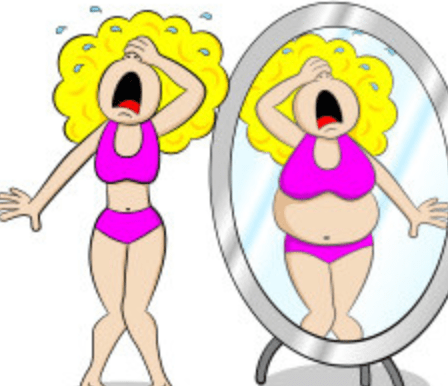
Within our society body dismorohic disorder is a huge problem, as our use of social media platforms have enabled us to view other peoples pictures of themselves which allows people to compare themselves to others. Apps such as facetune have helped people posting pictures to edit their bodies, face and anything they see that is a flaw for the ‘perfect’ picture for the Instagram feed or to post on your story on snapchat. Even though these posts may look perfect, most of the time these pictures have been edited to look how the person wants people to see them.

Body dysmorphic disorder is when you feel like a certain part of your body or your face has a flaw, and you get anxious about this flaw to the point you become obsessed with it, when usually to other people this flaw is not one at all. It can be to do with weight, height, facial features or body and people will do anything to make sure they get it fixed. More often then not, people will look to surgery, or wear tons of makeup to hide this flaw and make themselves feel better; although this is their choice, there are ways to get rid of this feeling as it is a disorder. Below are the common symptoms of body dysmorphic disorder found on the NHS website :

Symptoms of body dysmorphic disorder (BDD)

You might have BDD if you:

  • worry a lot about a specific area of your body (particularly your face)
  • spend a lot of time comparing your looks with other people’s
  • look at yourself in mirrors a lot or avoid mirrors altogether
  • go to a lot of effort to conceal flaws – for example, by spending a long time combing your hair, applying make-up or choosing clothes
  • pick at your skin to make it “smooth”

(https://www.nhs.uk/conditions/body-dysmorphia/ )

This can really ruin your life as you obsess, and it definitely will put a strain on relationships, work life and everyday life as well.

‘Body Dysmorphic Disorder affects 1.7% to 2.9% of the general population — about 1 in 50 people’ (https://bdd.iocdf.org/professionals/prevalence/ )

If you feel like you or someone you know has these symptoms, then there are things that you can do in order to help:

Call your GP and arrange an appointment. They will be able to give you helpful information, and they will also assess your symptoms by asking questions about how they effect your life. They will be able to find out the severity of the symptoms and then find a way to help you. It is important to find help as it is a disorder that is likely to carry on if no treatment is given.

On the NHS website they say there are various treatments depending on your symptoms:

‘If you have relatively mild symptoms of BDD, you should be referred for a type of talking therapy called cognitive behavioural therapy (CBT), which you have either on your own or in a group.’

‘If you have moderate symptoms of BDD, you should be offered either CBT or a type of antidepressant medication called a selective serotonin reuptake inhibitor (SSRI).’

‘If you have more severe symptoms of BDD or other treatments do not work, you should be offered CBT together with an SSRI.’

(https://www.nhs.uk/conditions/body-dysmorphia/ )

Above is an interesting video from the BBD Foundation that shows what it feels like when you have the disorder.
You Are Not Alone

BIPOLAR DISORDER

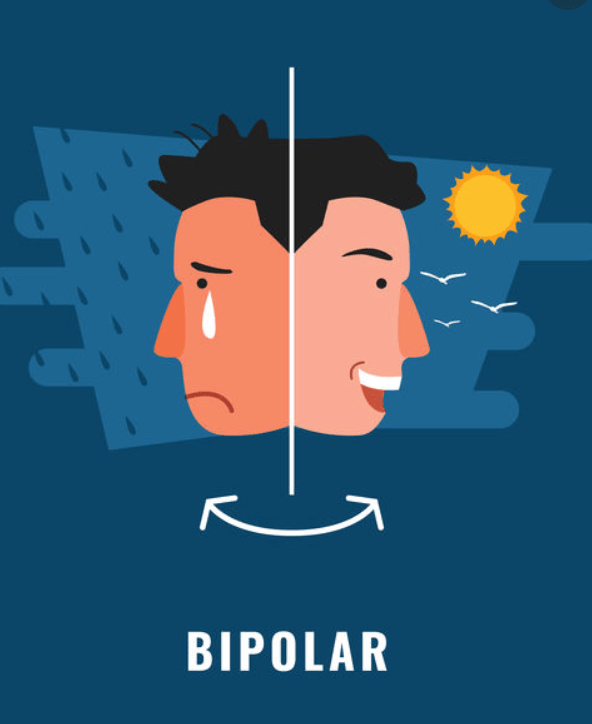
‘Bipolar disorder is characterised by extreme mood swings. These can range from extreme highs (mania) to extreme lows (depression)’ – https://www.nhs.uk/conditions/bipolar-disorder/symptoms/

Switching from lows to highs must feel confusing, and also causes problems for people around you as they never know how you’re going to act. It is so important to look out for the signs that this is occurring because they will impact yourself or someone you know drastically and cause peoples lives to be ruined.

These are symptoms found on the NHS website for Bipolar of both depression and mania which someone may experience when they have Bipolar: ( https://www.nhs.uk/conditions/bipolar-disorder/symptoms/)

Depression

During a period of depression, your symptoms may include:

  • feeling sad, hopeless or irritable most of the time 
  • lacking energy 
  • difficulty concentrating and remembering things 
  • loss of interest in everyday activities 
  • feelings of emptiness or worthlessness 
  • feelings of guilt and despair 
  • feeling pessimistic about everything 
  • self-doubt 
  • being delusional, having hallucinations and disturbed or illogical thinking 
  • lack of appetite 
  • difficulty sleeping 
  • waking up early 
  • suicidal thoughts

Mania

The manic phase of bipolar disorder may include:

  • feeling very happy, elated or overjoyed 
  • talking very quickly 
  • feeling full of energy 
  • feeling self-important 
  • feeling full of great new ideas and having important plans 
  • being easily distracted 
  • being easily irritated or agitated 
  • being delusional, having hallucinations and disturbed or illogical thinking 
  • not feeling like sleeping 
  • not eating 
  • doing things that often have disastrous consequences – such as spending large sums of money on expensive and sometimes unaffordable items 
  • making decisions or saying things that are out of character and that others see as being risky or harmful

If you think you or someone you know is experiencing any of these symptoms you need to contact the NHS on 111 and seek guidance on how to handle this disorder.

Bipolar will effect everyday life, as after a low episode the person experiencing it won’t understand their own behaviour, as when they’re in the episode they react differently and therefore think differently too. Working with bipolar is a big struggle and people with the disorder may find it hard keeping a job, as in a work environment finding a way to control the episodes is nearly impossible. Relationships with friends and family or girlfriends/boyfriends etc may be strained due to these episodes and not being able to control them.

BipolarUK – ( https://www.bipolaruk.org/faqs/bipolar-the-facts ) says that ‘1% to 2% of the population experience a lifetime prevalence of bipolar and recent research suggests as many as 5% of us are on the bipolar spectrum’ which doesn’t seem a lot, but the people who are effected by it are effected badly and their lives change completely. They also say ‘Bipolar increases the risk of suicide by 20 times’ which is why it is so important that if you think you have these symptoms you need to seek medical guidance in order to make sure you don’t become depressed due to this and then harm yourself or others in an episode.

These are numbers and emails you can contact in order to find help

BipolarUK Helpline

0333 323 3880
bipolaruk.org

Samaritans helpline – 116 123
samaritans.org
Freepost RSRB-KKBY-CYJK
PO Box 90 90
Stirling FK8 2SA
jo@samaritans.org
They provide 24-hour support for anyone struggling who needs to talk.

Interesting video on Bipolar, providing more information on the disorder.

Below is a quote from famous writer,actor and comedian Stephen Fry who suffers from Bipolar and how he sees bipolar : (https://www.goodreads.com/quotes/7570063-i-ve-found-that-it-s-of-some-help-to-think-of)

“I’ve found that it’s of some help to think of one’s moods and feelings about the world as being similar to weather. 

Here are some obvious things about the weather:

It’s real. 
You can’t change it by wishing it away.
If it’s dark and rainy, it really is dark and rainy, and you can’t alter it.
It might be dark and rainy for two weeks in a row.

BUT
it will be sunny one day.
It isn’t under one’s control when the sun comes out, but come out it will.
One day.

It really is the same with one’s moods, I think. The wrong approach is to believe that they are illusions. Depression, anxiety, listlessness – these are all are real as the weather – AND EQUALLY NOT UNDER ONE’S CONTROL. 
Not one’s fault.

BUT
They will pass: really they will.

In the same way that one really has to accept the weather, one has to accept how one feels about life sometimes, “Today is a really crap day,” is a perfectly realistic approach. It’s all about finding a kind of mental umbrella. “Hey-ho, it’s raining inside; it isn’t my fault and there’s nothing I can do about it, but sit it out. But the sun may well come out tomorrow, and when it does I shall take full advantage.”

ANXIETY

Everyone experiences Anxiety at some point in their lives, some more than others, and some people may suffer from it more severely which is when someone may look for help as it is hindering their lives and stops them from being able to get things done day to day.

The main symptoms for Anxiety are ‘increasing heart rate and breathing, concentrating blood to your brain’ and more severely with ‘nausea and feeling lightheaded.’ (https://www.healthline.com/health/anxiety/effects-on-body#3)

There are different types of anxiety disorders and its important to know which one that you or someone you may know has. On the Healthline website (linked above) they say that people will be diagnosed with what is known as Generalised anxiety disorder which is ‘diagnosed when extreme worry about a variety of things lasts six months or longer. If you have a mild case, you’re probably able to complete your normal day-to-day activities. More severe cases may have a profound impact on your life.’ Another is Social Anxiety Disorder which is where someone will have a ‘paralyzing fear of social situations and of being judged or humiliated by others. This severe social phobia can leave one feeling ashamed and alone.’ If you have this type of anxiety constantly it can ruin your life as it doesn’t allow you to leave your house because you’re worried all the time about what is happening around you, or if people are looking at you and the constant feeling of stress which gets worse throughout the day. Although Anxiety is common it is a mental health problem that is one of main reasons that other mental health issues occur, such as depression.

If you believe you or someone you know has anxiety look out for these main signs:

MIND.ORG – https://www.mind.org.uk/information-support/types-of-mental-health-problems/anxiety-and-panic-attacks/anxiety-symptoms/

  • a churning feeling in your stomach
  • feeling light-headed or dizzy
  • pins and needles
  • feeling restless or unable to sit still
  • headaches, backache or other aches and pains
  • faster breathing
  • a fast, thumping or irregular heartbeat
  • sweating or hot flushes
  • problems sleeping
  • grinding your teeth, especially at night
  • nausea (feeling sick)
  • needing the toilet more or less often
  • changes in your sex drive
  • having panic attacks.

These are important to look out for, as it may help someone or yourself to get diagnosed and find help where is needed. There are helpings and websites that you can use if you are experiencing anxiety and it is taking over your life.

The NHS are always available to help by calling 111 – Call and let them know you are feeling anxious and they will give you the best advice on how to get help, including GP’s that you can see.

Here is a video that shows a few simple tips for dealing with anxiety.

Due to everyone in society using mobile phones, we have an easy way to access help, as well as finding ways to calm down and relax on your own, for example ASMR (Autonomous sensory meridian response) which is something that a lot of people listen to on YouTube in order to help relax. I personally have used ASMR videos to help relax me when I am feeling stressed and anxious and I generally believe these work so well. There are also videos available like the one shared below that help with deep relaxation to prevent anxiety, and stress. This however doesn’t work for everyone so you have to find something that works for you, but it is always good to know you have other options to help calm yourself down at home when needed.


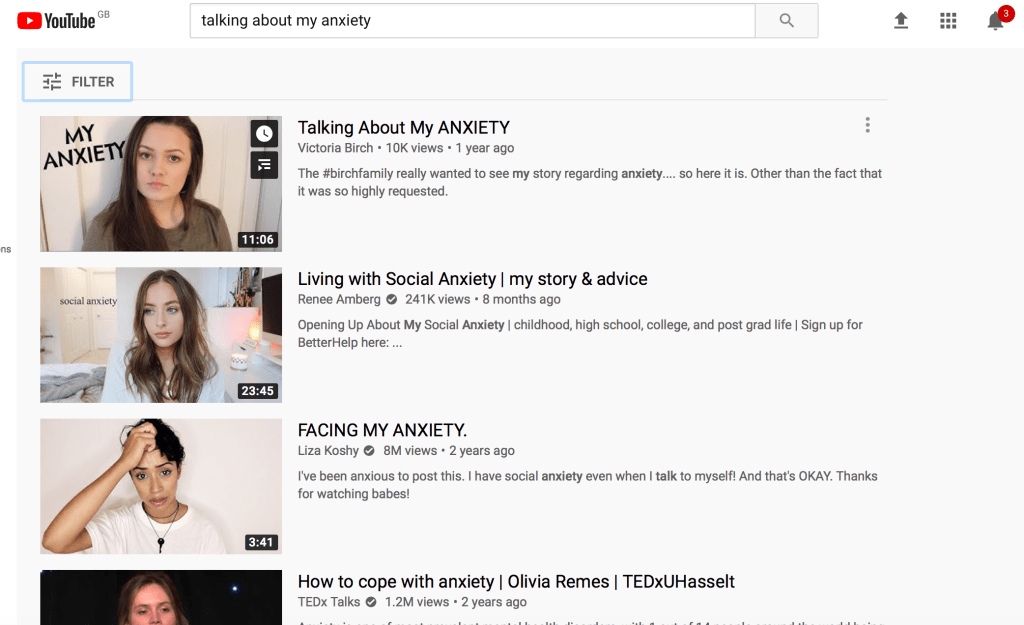
One thing to remember is that you are not alone, and many people are experiencing the same thing as you. If you want to hear other peoples stories about anxiety, looking up ‘Talking about my Anxiety’ on YouTube will give you many videos of people telling their own stories of how they coped with it, and how they also didn’t. This may help you or someone you know, feel like they are not alone and then will be able to relate to it.

Mental Health -Why is it so important?

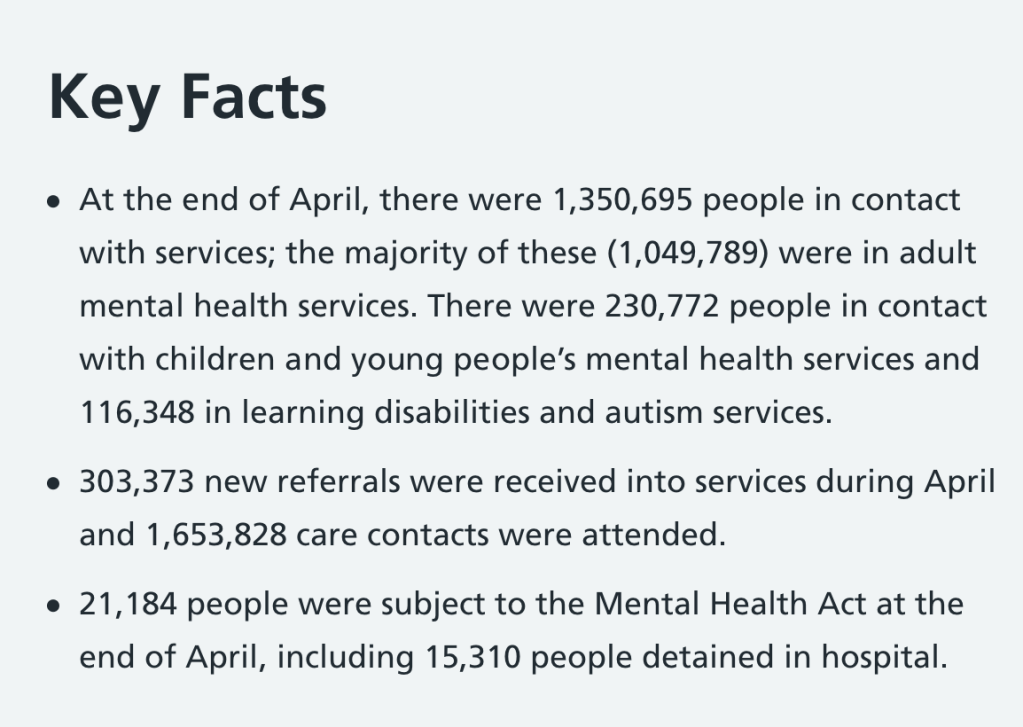
Mental health is an ongoing and ever growing issue within society as more and more people everyday are experiencing mental health problems. A lot of people go through life not knowing that they even have one, and therefore deal with it on their own. It is so important that there is a better understanding about mental health, as you can not only help yourself but others around you. Below is a screengrab of the statistics from 2019 found on the NHS mental health page:

Here you can see the huge amount of people with mental health illnesses. This number is forever increasing.
https://digital.nhs.uk/data-and-information/publications/statistical/mental-health-services-monthly-statistics/final-april-provisional-may-2019

Mind.org presented information on their website about ‘How common are mental health problems’ and they said that ‘Approximately 1 in 4 people in the UK will experience a mental health problem each year’ and ‘In England, 1 in 6 people report experiencing a common mental health problem (such as anxiety and depression) in any given week.’ (https://www.mind.org.uk/information-support/types-of-mental-health-problems/statistics-and-facts-about-mental-health/how-common-are-mental-health-problems/ )

As the number of people experiencing mental health problems increases, so does the importance of knowing what to do when you have it, or someone you know has it and how you can help them. This is what MHA (mental health awareness) blog is here to do. To help provide information that people will be able to engage with, without feeling worried, as sometimes looking at websites like the NHS and Mind.org etc can be daunting and worrying, and as a member of the younger generation I find social media platforms and blogs more exciting to use and read. This blog is created with the hope that more members of the younger generation will be able to see the content and share it on to their friends, family members etc as the blog will be easy to read with lots of information all in one area, while also providing links for further information.

Remember Always be kind you never know what someone is dealing with.